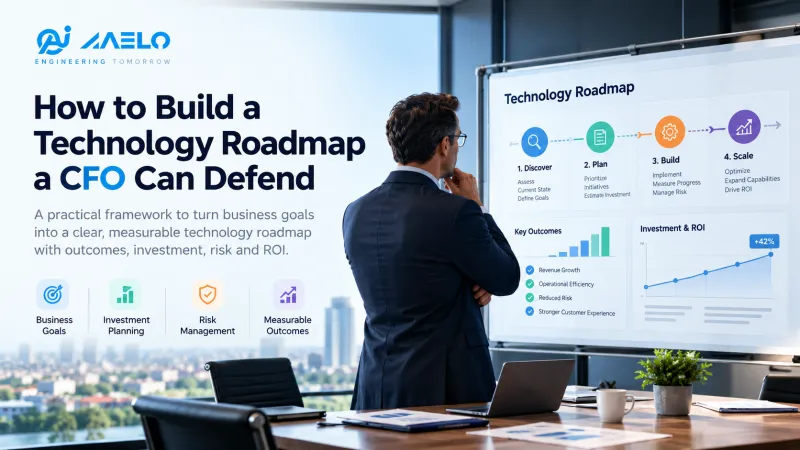
Executive answer: A technology roadmap becomes executive-ready when every major initiative explains the business problem, expected outcome, investment, risk, dependency and measurement method. A list of technical projects is not a strategy.
Start with business priorities
Map technology initiatives to priorities such as revenue growth, operational efficiency, customer experience, risk reduction or geographic expansion. An initiative that cannot be connected to one of them needs a better justification than “it is overdue”.
Classify technology work
Four buckets are usually enough:
Run: keep critical systems reliable.
Protect: reduce security and operational risk.
Improve: remove bottlenecks and technical debt.
Grow: create new capabilities.
The proportions tell leadership something on their own. A roadmap that is entirely “Grow” is usually hiding accumulating risk.
Quantify where possible
Metrics may include hours saved, revenue enabled, downtime reduced, processing time reduced, conversion improved, infrastructure cost avoided or security risk reduced.
Not every benefit reduces to a precise financial number. Where measurement is uncertain, state the assumptions and use ranges — a defensible range beats a confident figure nobody can source.
Show dependencies
Executives need to understand why one initiative must precede another. Reliable data architecture may need to come before an AI automation programme, for example; sequencing them the other way produces an expensive disappointment.
Use decision gates
Large initiatives should have checkpoints:
Discovery complete.
Business case validated.
Architecture approved.
Pilot successful.
Production readiness approved.
Scale decision.
Gates make it acceptable to stop. Without them, the only options are continue or fail, and organisations choose continue for too long.
The AAELO perspective
The purpose of a roadmap is not to predict every engineering task for three years. It is to create enough strategic clarity for leadership to decide what to invest in, what to defer and what risk to accept knowingly.
Build the roadmap around business capabilities first and technology initiatives second. If you need an independent view of the current estate before committing to a plan, that is what our technology consulting engagements produce. Tell us what you are planning.